Incentives
Tangle’s incentives come from two sources:
- Service fees paid by customers when they create and run blueprint services.
- TNT incentive budgets funded to the protocol (no automatic minting).
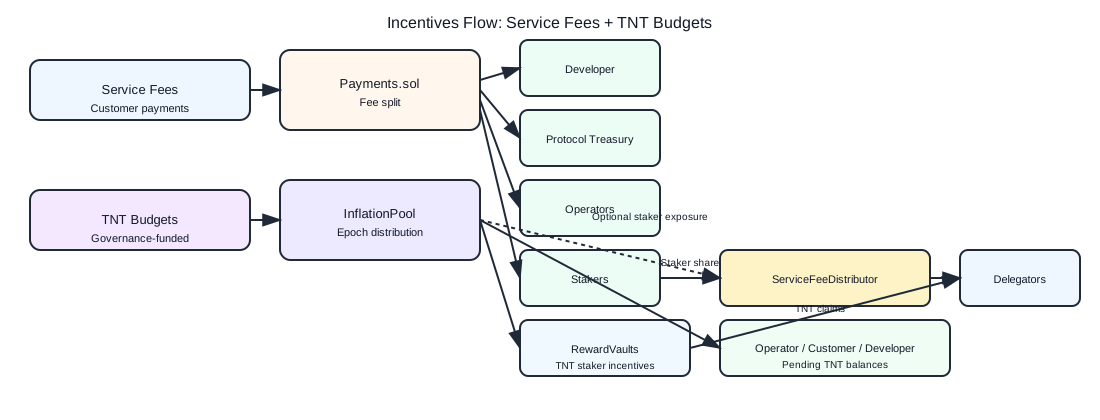
Service fees split through Payments.sol; TNT budgets flow through InflationPool, RewardVaults, and ServiceFeeDistributor.
Claim paths: staker fees + staker inflation via ServiceFeeDistributor, TNT staking incentives via RewardVaults, and operator/customer/developer TNT via InflationPool.
Code references: Payments.sol, ServiceFeeDistributor.sol, InflationPool.sol, RewardVaults.sol, TangleMetrics.sol
Service Fees
Customers pay for blueprint services using the chain’s native token or an ERC-20 payment token (including TNT). Fees are split between:
- Developer (blueprint owner, or a payout address returned by the blueprint’s service manager)
- Protocol treasury
- Operators (weighted by that service’s per-operator exposure)
- Stakers (delegators who staked with the chosen operators)
The default split is 20% developer / 20% protocol / 40% operators / 20% stakers, and can be updated by governance.
Staker shares are routed per-operator to the on-chain ServiceFeeDistributor, which distributes fees to delegators based on:
- Delegated amount (and optional lock multiplier)
- Blueprint selection (
AllvsFixed) - Optional per-asset security requirements and operator commitments (and optional USD normalization via a price oracle)
TNT Incentives (Pre-Funded)
TNT incentives are distributed from a pre-funded on-chain pool:
InflationPoolholds TNT allocated by governance/treasury and distributes it in epochs.- The staking portion funds
RewardVaults, which pays TNT incentives for delegated assets (with a deposit cap per asset). - Other portions become claimable TNT balances for operators, customers, and developers.
- If
stakersBps > 0, a staker TNT budget is distributed by service exposure and routed throughServiceFeeDistributor.
Metrics and Scoring
The protocol can optionally record activity into a metrics contract (TangleMetrics) using best-effort hooks (failures do not block core protocol actions). Those metrics drive merit-based distributions in InflationPool.
- See Metrics and Scoring for details.
Why This Layout Works
- One staker fee path: Service fees always flow through
ServiceFeeDistributor, so payout math is consistent across tokens and services. - Budget clarity: Incentives only exist if governance funds them; there is no hidden inflation.
- Predictable integration: Developers can reason about exactly where funds go and how to claim them.